On this page
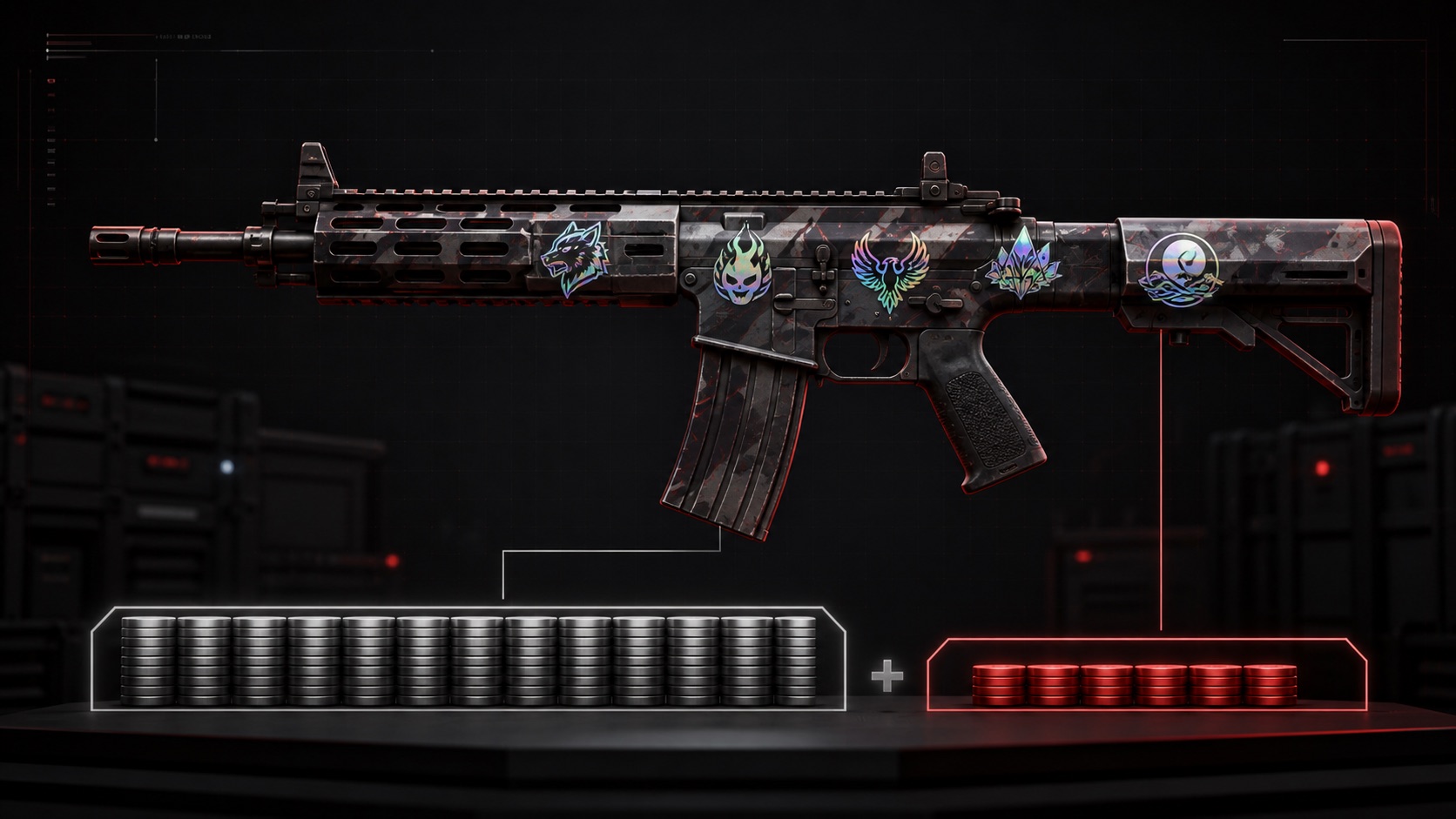
Stickers can add nothing, a small premium, or a substantial collector premium to a CS2 skin. There is no fixed percentage that works for every craft. The defensible value is the extra amount buyers have actually paid for a comparable stickered item over the same skin without that craft.
That distinction matters if you own a skin with expensive stickers or are considering a seller’s overpay. This guide explains sticker percentage, the variables that affect it, and a repeatable way to estimate a price range without pretending that one calculator can know the exact buyer.
Direct answer: Start with the clean skin’s value, identify the premium in comparable completed sales, and use the standalone sticker price only as a reference. Never add 100% of every sticker’s current listing price to the skin.
A CS2 sticker has three different values before and after application
The number beside a standalone sticker is not automatically the amount it adds to a weapon. A useful valuation separates three concepts:
| Value | What it measures | What it does not prove |
|---|---|---|
| Standalone sticker value | What an unapplied sticker may sell for as its own inventory item | What the sticker adds after it is consumed by a craft |
| Sticker premium | The extra amount a buyer pays for the stickered skin above a comparable clean skin | The full replacement cost of the stickers |
| Total craft value | Base skin value plus the defensible sticker premium | A guaranteed sale at the seller’s asking price |
Steam describes CS2 stickers as single-use items. Its CS2 sticker support page states that placement cannot be changed after application and that permanent removal does not return the sticker to the inventory.
Application therefore changes the asset. Before application, the sticker can be sold or placed on another weapon. Afterwards, its market value is expressed through one specific combination of weapon, finish, position, rotation, scrape state, and other applied stickers.
Sticker percentage describes an observed premium, not a universal rate
Traders often call the relationship between an applied sticker’s premium and its standalone price sticker percentage, shortened to SP%. The cleanest version of the calculation is:
Observed sticker premium = completed stickered-skin price
                         - comparable clean-skin price

Observed SP% = observed sticker premium
             / relevant standalone sticker value
             x 100
For a matching set, the denominator may be the combined standalone value of the stickers. That still does not make the percentage transferable to another craft. A five-sticker composition on a popular rifle is not equivalent to one sticker in a low-visibility position on a different weapon.
SP% is most useful as a description of a transaction that happened. It becomes much weaker when a calculator assigns a percentage first and calls the result market value.
Recent community threads illustrate the problem. Players discussing maximum sticker percentages and applied sticker values suggest sharply different ranges. Those comments are useful evidence of uncertainty, not a reliable rate card.
Eight factors determine how much stickers add to a CS2 skin
Sticker value is a buyer-demand problem with several interacting variables. Check all eight before using a percentage.
| Factor | Why it can change the premium | What to compare |
|---|---|---|
| Sticker identity | Rarity alone does not guarantee demand; teams, players, artwork, finish, and available supply matter | The same sticker variant, not a similarly named edition |
| Base skin | Weapon popularity, finish, exterior, float, StatTrak or Souvenir status, and pattern can change the buyer pool | The closest clean version of the exact skin |
| Placement and rotation | Buyers may value visibility, alignment, overlap, or a deliberate visual effect | The same or visually equivalent placement |
| Craft composition | A matching 4x or 5x set can be more coherent than unrelated stickers | Same sticker count and composition |
| Scrape state | Scraping permanently changes appearance and cannot be undone | The exact or closest visible scrape state |
| Craft scarcity | A hard-to-recreate combination may appeal to collectors | Number and quality of comparable crafts, not merely “one of one” claims |
| Liquidity | A rare craft can still take a long time to find its buyer | Completed sales, offers, and time listed |
| Sale venue | Steam Wallet value and withdrawable cash are different outcomes | Prices from the same settlement type and venue |
Valve expanded these variables in CS2. The February 6, 2024 release notes added flexible position and rotation, precision zoom, and support for up to five stickers on a weapon. That makes “slot one is always best” too crude for modern crafts: the visible composition now depends on coordinates, angle, overlap, and the weapon model.
Applied sticker value must be estimated from genuinely comparable CS2 skins
The best practical method is to build a range from completed evidence. A listing can be useful for discovering supply, but it only shows what a seller wants.
Step 1: Record the exact CS2 item
Write down the weapon, finish, exterior, float, StatTrak or Souvenir status, pattern index, trade status, and any other exceptional attribute. These variables affect the clean base value before stickers enter the calculation.
Step 2: Inventory every applied sticker
Record the full sticker name and edition, finish such as holo or gold, placement, rotation, scrape state, and whether the craft is matching. Screenshots help, but an in-game inspection is better for checking overlap and visibility.
Step 3: Establish the clean-skin baseline
Use recent completed sales for the closest version without a meaningful sticker premium. Do not use a different exterior or ignore a rare float simply because the weapon finish matches.
When the base skin itself has a pattern or float premium, estimate that component first. Otherwise, the later subtraction will wrongly attribute the skin’s own premium to its stickers.
Step 4: Find the closest completed stickered sales
Start with the same skin and same sticker arrangement. If none exist, loosen one variable at a time:
- same skin and same sticker, different comparable placement;
- same skin and same matching set, nearby float;
- same sticker composition on a similar-demand skin;
- same rare sticker on the same weapon family;
- active offers only when no completed evidence exists.
Each step away from an exact match widens the uncertainty range. Do not hide that uncertainty behind extra decimal places.
Step 5: Subtract the clean value from each comparable sale
The difference is the observed craft premium for that transaction. Calculate SP% only after this subtraction, using a standalone sticker reference from the same period and settlement type where possible.
Step 6: Adjust for differences and choose a range
Adjust for better or worse placement, intact versus scraped stickers, matching versus mixed composition, float, pattern, venue, and sale date. Use the lower part of the range for a faster sale and the upper part only when you can wait for a specialist buyer.
This method does not produce certainty. It produces an estimate whose assumptions can be inspected and challenged.
Three fictional examples show why CS2 sticker premiums are not interchangeable
The following numbers are fictional and exist only to demonstrate the method. They do not describe current prices or recommend a marketplace.
A single ordinary sticker may add no measurable premium
Assume a clean skin has recent comparable sales around $48–$51. One copy with a single intact sticker sells for $50, while the standalone sticker reference is $20.
There is no clear evidence of sticker overpay because the stickered sale sits inside the clean skin’s normal range. Calling the premium $20 would confuse replacement cost with buyer behaviour.
A coherent matching craft can show a repeatable premium
Assume a clean skin sells around $100. Several closely matched four-sticker crafts complete between $136 and $148, and the four standalone stickers have a combined reference value of $240.
| Calculation layer | Fictional result |
|---|---|
| Clean base value | $100 |
| Stickered completed-sale range | $136–$148 |
| Observed craft premium | $36–$48 |
| Standalone sticker basket | $240 |
| Observed SP% range | 15%–20% |
The useful conclusion is not “all matching crafts are worth 15–20%.” It is that this specific group of comparable transactions supports that range under those conditions.
A rare craft without comparables needs an evidence range, not a formula
Assume a seller claims a new craft is unique. No completed sale exists, the base skin is $400, and the consumed stickers have a high standalone reference value.
The correct output is not an exact appraisal. Record the base value, cost to recreate, closest imperfect sales, credible buyer offers, and time on market. Present a wide range with low confidence until a real transaction narrows it.
“One of one” describes scarcity only if the claim is verified. It does not prove that two buyers want the item or that either will meet the seller’s ask.
Sticker placement matters more after CS2 introduced flexible positioning
Old slot-based rules can miss what the buyer actually sees. CS2 allows user-selected position and rotation, so value may depend on whether the sticker complements the finish, covers an important part of the art, creates a readable combination, or is partly hidden during normal play.
Placement can also work against a craft. An expensive sticker in an awkward or obscured position may draw less demand than a cheaper sticker that completes the design. A price check should therefore include an inspect view, not only a list of sticker names.
Do not assume that visual quality is objective. Treat it as a demand hypothesis and look for similar completed crafts.
Scraping a CS2 sticker permanently changes the item and its buyer pool
Steam says a sticker can be scraped repeatedly until it is removed. The October 2024 CS2 update added a precise wear selector and states that an applied sticker’s scrape level can only increase.
That irreversibility matters for valuation. A scraped sticker might add less because part of its design is gone, but a deliberate scrape can also be central to a particular visual craft. There is no dependable linear rule such as “20% scraped means 20% less premium.”
Compare the exact appearance. If no comparable scraped craft has sold, label the adjustment as subjective and widen the range.
A seller should price a unique CS2 sticker craft by testing demand carefully
When no close completed sales exist, separate what you know from what you are testing:
- Known: the clean skin’s comparable value, exact sticker identities, scrape state, placement, and current standalone references.
- Inferred: aesthetic quality, craft scarcity, likely collector segment, and an initial premium range.
- Unknown: the highest executable buyer offer and how long the sale may take.
Start with a reasoned ask, preserve the screenshots and comparable links used, and record serious offers. If the item receives no interest, reduce the premium gradually rather than interpreting silence as proof that the original valuation was correct.
An automated calculator can be a screening tool, but it cannot see every visual interaction, verify private sales, or create liquidity. Treat its output as another estimate, not an appraisal certificate.
Five mistakes make CS2 stickered skins look more valuable than the evidence supports
- Adding the full price of every standalone sticker. Applied stickers cannot be detached and resold as the original inventory items.
- Using one ambitious listing as a comparable sale. An ask is not a completed transaction.
- Comparing different base skins. Float, pattern, exterior, and StatTrak status can create the apparent premium.
- Ignoring the sale currency. A Steam Wallet result and net external cash are not interchangeable; our Steam price versus cash value guide explains the difference.
- Treating rarity as guaranteed liquidity. A unique craft still needs a willing buyer, and the highest price may require a long wait.
Unsolicited direct-trade messages create a separate risk. Do not let a claimed price check, middleman, payment screenshot, or urgent offer replace the supported trade and payment flow you intended to use.
The best CS2 sticker valuation is a documented range, not one percentage
To estimate how much stickers add, begin with the exact clean skin, collect completed sales for similar crafts, subtract the base value, and explain every adjustment. Use SP% to summarize that observed premium, not to invent it.
A strong price check should be reproducible by another reader. It should show the item attributes, comparison dates, settlement type, completed-sale evidence, calculation, uncertainty, and expected sale-speed tradeoff.
If the item first needs to arrive from a third-party service, separate valuation from delivery risk using our CS2 skin withdrawal delay guide. The value of an on-screen item is not yet the value of a tradeable item in your inventory.
Research boundary: CSGO Cash reviewed public Valve and Steam documentation, current search results, Ahrefs keyword estimates, and recurring community questions under our editorial methodology. We did not sell a stickered skin, verify private trades, or obtain marketplace account data for this article. Prices, buyer demand, and item rules can change; recheck the live item and venue before acting.
When you need completed-sale evidence, compare venues by custody model and fee disclosure in our CS2 skin marketplace ranking and use the CSFloat vs Skinport comparison to see how P2P and bot-held inventory differ.